

20 Jul Is It Illegal to Let Car Wash Water Run Into a Storm Drain?
Short answer: if you wash vehicles for money, yes. Letting wash water flow into a storm drain violates the federal Clean Water Act and the stormwater ordinance of nearly every city and county in the country.
For professional detailers, there is no gray area. The good news is that staying legal is easier than most people think.
Here is what the law actually says, why storm drains are treated so strictly, and how mobile detailers wash legally in any location.
Storm Drains Are Not Sewers
The confusion starts with a reasonable assumption: water that goes down a drain gets treated. For the drains inside a building, that is true. They connect to the sanitary sewer, which flows to a treatment plant.
Storm drains are a completely separate system. The grates in streets, gutters, and parking lots exist to prevent flooding. In most municipalities, they discharge directly into the nearest creek, river, lake, or bay with no treatment of any kind.
As a result, whatever enters a storm drain enters local waterways as is.
That is why the law treats a storm drain like a river. Functionally, it is one.
What the Law Says
Two layers of law apply to wash water in a storm drain:
- Federal law. The Clean Water Act prohibits discharging pollutants into waters of the United States without a permit. Wash water counts as polluted water, and the EPA’s own guidance on vehicle washing says wash water must be kept out of storm drains and either directed to the sanitary sewer or collected for proper disposal.
- Local ordinances. Cities and counties operate their storm systems under state permits that require them to police what enters the drains. Their ordinances prohibit non-stormwater discharges, and many publish rules specifically for mobile washing businesses. Local inspectors, not the EPA, are who you will actually meet. Dirty water flowing from a wash job to a gutter is also one of the most visible violations there is.
For a full breakdown of the rules, see our guide to mobile detailing wastewater regulations.
But My Soap Is Biodegradable
Biodegradable soap is still a pollutant on its way to a waterway. Detergents strip the protective mucus layer on fish and are toxic to aquatic life long before they finish biodegrading.
And soap is only part of what is in wash water. A typical exterior wash rinses off motor oil and grease, brake dust containing copper and other heavy metals, road grime, and fine sediment.
None of it belongs in a creek, and the ordinance does not carve out an exception for green products.
What About Washing My Own Car at Home?
Enforcement priorities differ for a homeowner washing one car versus a business washing cars every day. Many jurisdictions tolerate occasional residential car washing, and some encourage residents to wash on the lawn or use commercial car washes instead.
However, a paid detailer working in a customer’s driveway is a commercial operation, and commercial wash water is expected to be contained no matter where the job happens.
If you are getting paid, assume the strict rules apply to you.
The Real Cost of Getting It Wrong
A first violation often brings a warning and required cleanup, but fines can follow quickly. Many ordinances also allow penalties per incident or per day.
The bigger risk is commercial. Property managers face stormwater liability of their own, and a detailer who causes a violation on their property does not get invited back.
In a business built on standing accounts and referrals, that is the expensive part.
How to Wash Legally, Anywhere
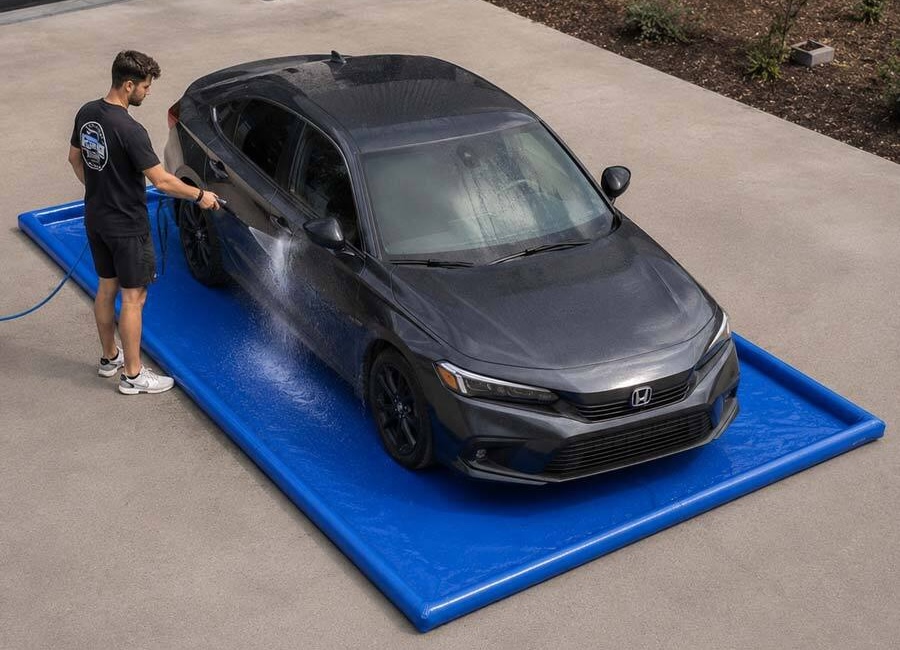
Mobile detailers stay legal by keeping wash water out of the storm system entirely. The standard setup is a water containment wash mat with a reclamation system:
- A heavy-duty bermed mat goes under the vehicle and captures the wash water.
- A submersible pump at the mat’s low point moves water through a hose into a storage tank while you work.
- After the job, you dispose of the tank’s contents at an approved location, usually a sanitary sewer connection with permission. See our guide on how to dispose of reclaimed wash water.
Setup adds a few minutes per job. In return, it converts the biggest legal risk in mobile detailing into a selling point that wins commercial accounts.
Frequently Asked Questions
Is it illegal even if the drain is on private property?
Usually, yes. Parking lot drains typically connect to the same municipal storm system or discharge to the same waterways. The ordinance applies to the discharge, not to who owns the pavement.
What if the water evaporates before reaching a drain?
If wash water genuinely cannot reach the storm system, some jurisdictions consider it acceptable. However, you are betting a violation on evaporation beating gravity. Containment removes the gamble.
Can I discharge to a sanitary sewer instead?
Often, yes, with the property owner’s permission and subject to local sewer rules. That is exactly why detailers reclaim water into a tank: it lets you move the water to a legal disposal point instead of hoping one is nearby.
Does a rinseless or waterless wash solve this?
For light exterior work, it can, since there is little or no runoff. But rinse jobs, engine bays, wheels, and extractor waste all produce water you must contain. As a result, most professionals carry a mat and reclaim setup.
Keep It Off the Street and On the Mat
The rule is strict, but meeting it is simple.
Rightlook.com carries car wash mats and grey water containment systems for professional detailers, including a complete Wash Mat Kit Water Reclamation System with mat, pump, hose, scoop, and wastewater tank.
Call or text 858-271-4271 and we will help you pick the right setup.
Image note: Some images in this article may be AI-generated or AI-enhanced for illustrative purposes and may differ from the actual product.