

20 Jul Car Wash Water Reclamation Systems: The Complete Guide for Auto Detailers
If you run a mobile detailing business, there is one question that can make or break your access to the most profitable jobs in your market: what happens to your wash water when it leaves the vehicle?
Let it run down the street and into a storm drain, and you are violating the federal Clean Water Act along with most local stormwater ordinances. Capture it, and suddenly you can wash cars legally almost anywhere, including office parks, dealership lots, HOA communities, and commercial properties that turn away every detailer who cannot prove compliance.
A car wash water reclamation system is how you capture it. This guide covers what these systems are, why regulations require them, how they work, and how to choose between a standalone wash mat and a complete system with a pump and tank.
What Is a Car Wash Water Reclamation System?
A car wash water reclamation system is a set of equipment that contains the water you use to wash a vehicle, then collects it for proper disposal instead of letting it flow into the ground or a storm drain.
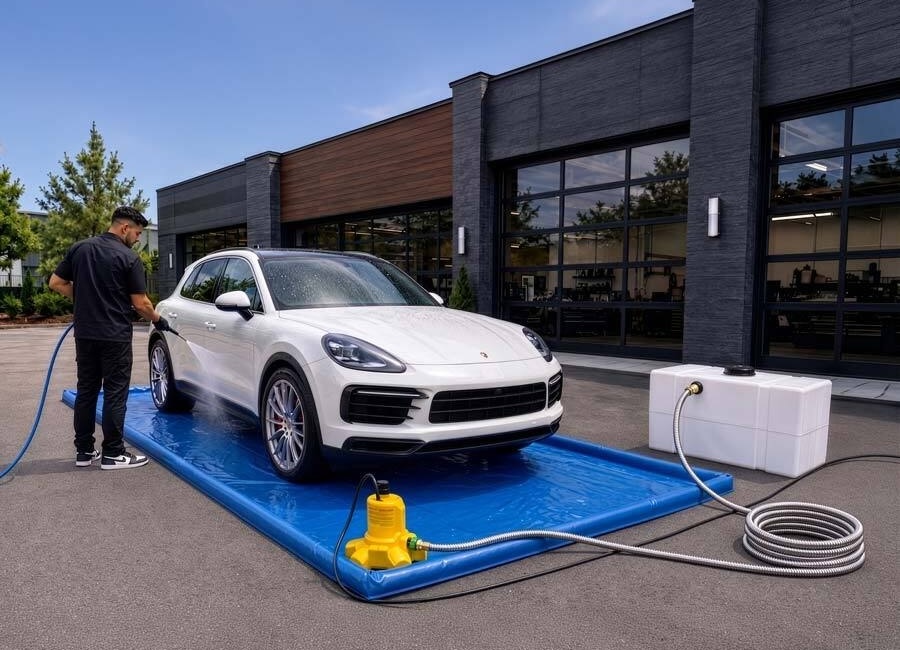
A complete mobile setup typically includes four components:
- A wash mat. A heavy duty vinyl mat, usually around 10 by 20 feet, with raised edges or berms. You park the vehicle on the mat and wash it there. The mat catches everything: soap, water, grease, oil, brake dust, road grime, and grit.
- A reclaim pump. A submersible pump sits at the low point of the mat and moves the pooled water off the mat as you work. A quality flat pump needs only about three sixteenths of an inch of water to start pumping and removes water down to a sixteenth of an inch, which is close to dry.
- A discharge hose. A hose (25 feet is common) carries water from the pump to your storage tank.
- A storage tank. A poly tank holds the reclaimed wash water until you can dispose of it properly. A drain valve at the bottom lets you empty it at an approved location.
Some detailers start with just the mat and use a wet vac or a puddle scoop with a mesh filter to pull water off it. Others go straight to the full pump and tank system so the mat stays clear while they work. We compare both approaches below.
Why Detailers Need Water Reclamation
There are two reasons to invest in reclamation, and the second one is the reason most detailers actually buy.
1. It is the law
Under the federal Clean Water Act, discharging wash water into a storm drain or waterway is illegal without a permit. Storm drains are not connected to sewage treatment in most cities. They flow directly to creeks, rivers, and the ocean. That means the soap, oil, heavy metals, and grit rinsing off a customer’s vehicle go straight into local waterways.
The EPA’s stormwater best management practices for vehicle washing are clear: wash water must be contained and directed to a sanitary sewer or collected for approved disposal. On top of the federal rules, most cities and counties run their own stormwater programs with inspectors, fines, and specific requirements for mobile businesses. Some jurisdictions require mobile detailers to document how they contain and dispose of wash water before issuing a business license.
For a deeper look at the rules, see our guide to mobile detailing wastewater regulations.
2. It unlocks the best accounts
Commercial properties, office buildings, apartment complexes, and dealerships face their own stormwater compliance obligations. If a detailer lets wash water run into the parking lot drain, the property owner can be the one fined. So property managers ask one question before letting a detailer work on site: how do you handle your water?
Detailers who can answer with a containment mat and reclamation system win fleet contracts, standing appointments at office parks, and access to high end neighborhoods and HOA communities where runoff is prohibited. Detailers who cannot answer get turned away. Compliance is not just about avoiding fines. It is a sales tool.
How a Wash Mat Reclamation System Works
Here is the workflow on an actual job, start to finish.
- Lay out the mat. Unfold the wash mat on a flat or slightly graded surface and position the vehicle on top. Water will flow toward the lowest point of the mat.
- Place the pump at the low point. Set the submersible pump flat on the mat where water pools.
- Connect the hose and tank. Run the discharge hose from the pump to the inlet on your storage tank. Confirm the tank’s drain valve is closed.
- Wash the vehicle. Work normally. Wash water collects on the mat and flows to the pump.
- Power the pump. Once water accumulates, plug the pump into a GFCI protected outlet. It moves water through the hose and into the tank while you keep working.
- Finish and pack up. When the wash is done and the water is reclaimed, unplug the pump, drain any remaining puddles, and fold the mat. The water rides in your tank, not down the client’s driveway.
- Dispose of the water properly. Empty the tank at an approved location, typically a sanitary sewer connection with permission or an approved disposal site. Our guide to disposing of reclaimed wash water covers the options.
Total added time on a job is usually 10 to 15 minutes for setup and breakdown. That is a small price for legal access to locations your competitors cannot touch.
Wash Mat Only vs. Complete System with Pump and Tank
Should you buy just the mat, or the full kit? It depends on where you work and how you plan to handle water removal.
Mat only
A standalone wash mat contains the water, which satisfies the containment half of the compliance equation. You then need your own way to remove the water. Many detailers use a wet vac with a puddle scoop attachment, which has a mesh filter to keep grit out of the vacuum. This works well if you already carry a wet vac, do lower volumes, or work sites where you can transfer water directly to a sanitary sewer drain with permission.
Best for: detailers adding compliance capability on a budget, shops that already own vacuum equipment, and lower volume operators.
Complete system: mat, pump, hose, and tank
The full kit adds a submersible reclaim pump, discharge hose, and a wastewater storage tank. The pump runs while you wash, so water never builds up on the mat, and everything you reclaim is stored in a sealed tank with a drain valve for controlled disposal later. There is no wrestling a full wet vac, and no need to find a disposal point at the job site.
Best for: mobile detailers doing regular volume, anyone chasing fleet and commercial accounts, and operators in strict enforcement areas where an inspector may ask to see the full containment and disposal chain.
Rightlook.com sells both configurations: the wash mat and containment accessories on their own, and the complete Wash Mat Kit Water Reclamation System with a 10 by 20 mat, pump, 25 foot hose, scoop, and wastewater tank.
What to Look for When Buying
Not all mats and kits are built the same. Evaluate these points before you buy:
- Mat size. A 10 by 20 foot mat handles most cars, trucks, and SUVs with room to walk the perimeter. Oversized vehicles may need a custom size.
- Material and berm design. Look for heavy duty vinyl with a raised berm that holds water without collapsing under foot traffic or a rolling tire.
- Pump performance. A flat style submersible pump should start in shallow water and pump the mat nearly dry. Check that it is rated for continuous use and remember it should always run on a GFCI protected circuit.
- Tank capacity and fittings. The tank should hold a full job’s worth of water and include a proper inlet fitting and a drain valve you can open and close for controlled disposal.
- Ease of setup and teardown. You will do this on every job. A system that packs small and sets up in minutes protects your daily schedule.
- Supplier support. Buy from a supplier that serves professional detailers and can answer setup and compliance questions, not just ship a box.
What It Costs to Skip Reclamation
Fines for illegal discharge vary by jurisdiction, and repeat violations can escalate quickly. Local stormwater programs can issue citations per incident, and Clean Water Act penalties at the federal level can be severe for ongoing violations. Beyond fines, a citation can cost you the commercial account where it happened, and property managers talk to each other.
Compare that to the one time cost of a mat and reclamation kit that pays for itself with a handful of the commercial jobs it makes possible. This is one of the rare purchases that is both a legal requirement and a revenue generator.
Frequently Asked Questions
Do I need a water reclamation system if I use waterless wash products?
Waterless and rinseless methods reduce or eliminate runoff for exterior washes, and some detailers use them where containment is impractical. But any job involving a rinse, an extractor discharge, or engine and wheel cleaning produces wastewater you must contain. Most professional detailers carry a mat so they never have to turn down a job.
Is a wash mat required by law?
The law requires that wash water not enter storm drains or waterways. A mat and wash water reclamation system is the standard, practical way for a mobile business to meet that requirement. Some jurisdictions specifically list containment mats in their required best management practices for mobile washing.
How much water does a mat actually capture?
A properly bermed mat captures the large majority of your wash water. Roughly three quarters of the water used on a typical wash ends up on the mat, with the rest lost to evaporation and carry off on the vehicle.
Where do I dump the reclaimed water?
Never into a storm drain. Approved options usually include a sanitary sewer connection with the property owner’s permission or a municipally approved disposal site. Rules vary by city, so confirm with your local stormwater or wastewater authority. See our full guide on disposing of reclaimed wash water.
Can one person set this up alone?
Yes. The mat unfolds like a tarp, the pump and hose connect hand tight, and the tank stays on your trailer or truck. Setup is a one person job measured in minutes.
Wash Anywhere, Legally
A water reclamation system turns compliance from a liability into a competitive edge. You protect local waterways, you protect your business from fines, and you win the commercial and fleet work that runoff rules put out of reach for everyone else.
Rightlook.com has supplied professional detailers with training and equipment since 1998. Explore our car wash mats and grey water containment systems, or see the complete Wash Mat Kit Water Reclamation System with mat, pump, hose, scoop, and tank. Questions about the right setup for your business? Call or text 858-271-4271.
Image note: Some images in this article may be AI-generated or AI-enhanced for illustrative purposes and may differ from the actual product.