

26 Aug Inflatable Wash Pads vs. Foam Berm Wash Mats: Which Is Right for Detailers?
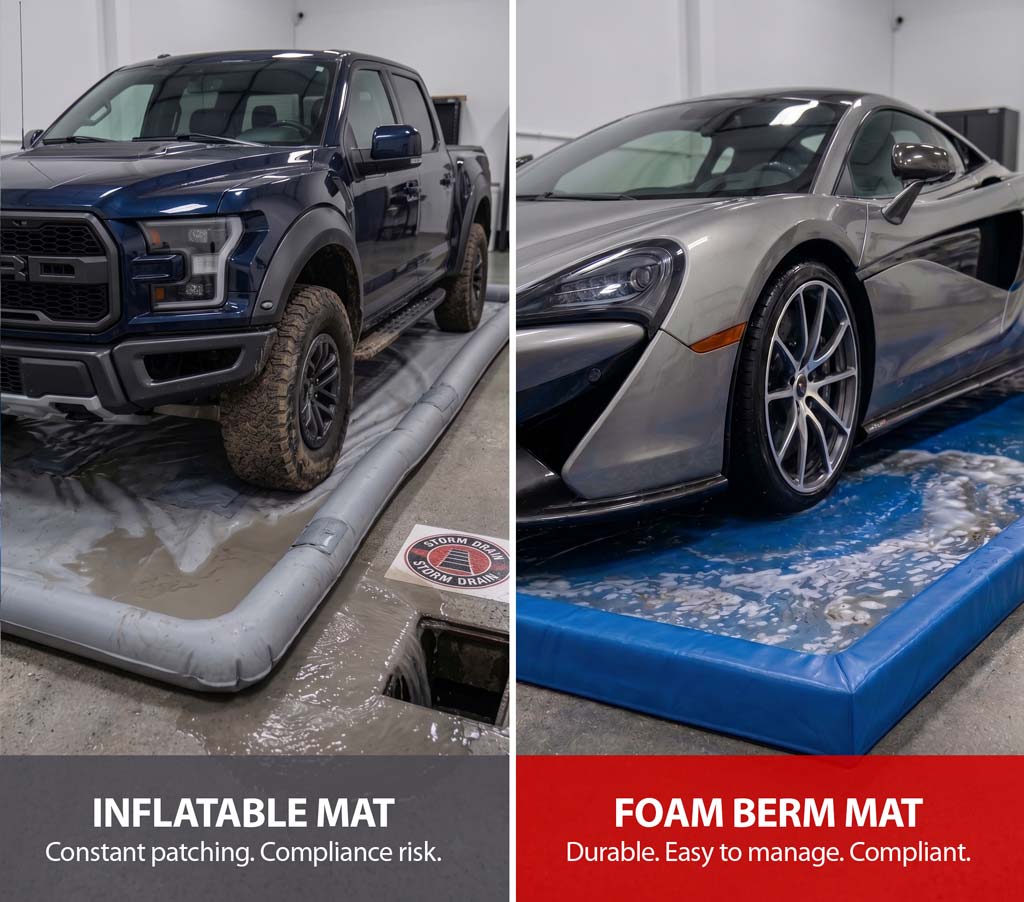
Water containment mats come in two basic designs. An inflatable wash pad uses air-filled walls to create a deep basin. Foam berm mats use flexible foam edges that hold their shape on their own. Both keep wash water off the ground, and both satisfy the containment half of stormwater compliance, at least on day one.
Day one is not the problem.
We have supplied professional detailers at Rightlook.com since 1998, and the pattern we see with inflatables repeats itself. They work well when new, then the leaks start, then the patching starts.
Eventually, the pad that looked comparable at purchase ends up costing more in hassle, repairs, and early replacement than a foam berm mat ever will. Here is the full comparison, including the part of the inflatable story that shows up after a season of real use.
How Each Design Works
Foam berm mats are heavy-duty vinyl mats with a continuous foam edge, typically a few inches high. The foam compresses when a vehicle drives over it and springs back to full height. As a result, setup is nothing more than unfolding the mat and positioning the vehicle.
Inflatable wash pads have perimeter walls you fill with air, usually with an electric pump. Inflated walls can stand taller than foam berms, creating a deeper basin that holds more water before anything needs to be removed.
Inflatable Wash Pad vs. Foam Berm Mat Setup Time
Foam berm: unfold, drive on, wash. Teardown is drain, fold, stow. There is no inflation step and nothing to deflate while you are trying to get to the next job.
Inflatable: position the pad, run the pump until the walls are firm, then reverse it all at the end. Add several minutes on each end of every job, plus a pump and power source that now live on your rig.
For a mobile business doing multiple jobs a day, the time difference compounds. Ten extra minutes per job across a five-job day is nearly an hour of unbilled work.
Durability: Where Inflatables Fall Apart
A containment mat fails at its edges, so compare what the edges are made of.
Foam is a solid material. It can be driven over thousands of times and does not care about thorns or hot pavement. A damaged section also still holds most of its height.
There is nothing to deflate, nothing to pressurize, and nothing that can quietly go flat in the truck overnight. The mat simply wears like the vinyl it is made of.
Why Inflatable Walls Fail
An inflatable wall is a pressure vessel, and pressure vessels leak. It is not a question of whether, but when.
Punctures from gravel and thorns, seams that fatigue from repeated inflation cycles, valves that loosen and weep, and material that degrades in sun and heat can all take the wall from full height to flat. Sometimes that happens mid-job with a vehicle sitting in the basin.
In our experience supplying detailers, this is the consistent story with inflatables. They hold up at first, then the slow leaks begin. The owner enters a cycle of finding leaks, patching, reinflating, and hoping.
Patches on flex points rarely hold long, and once a seam goes, the pad is done.
A failure mode is also a compliance problem. When a foam berm gets damaged, it still holds most of its height and the job can finish safely. When an inflatable wall goes flat, your containment is gone at that moment, on someone’s property, with dirty water looking for the storm drain.
For more information on why containment matters, see our guide to mobile detailing wastewater regulations. The EPA also publishes best management practices for vehicle washing.
Containment Capacity
This is where inflatables genuinely win. Taller walls hold more water, which matters if you flood a vehicle with rinse water faster than you remove it. It can also matter when containing equipment washing with heavy flow.
But for detailing, capacity is the wrong problem to solve with wall height.
The professional answer is to remove water continuously with a reclaim pump feeding a storage tank, so the mat never holds more than a shallow pool. With a pump moving water off the mat as you work, a few inches of foam berm is more containment than you will typically use.
You also skip the inflation ritual entirely. Our guide to complete water reclamation systems explains the pump and tank setup.
Weight, Packing, and Transport
Both designs fold into a manageable package, and quality versions of each are heavy because thick vinyl is heavy.
However, the inflatable adds its pump and repair kit to your loadout. The foam berm mat is one item with no accessories required to make its edges work.
Cost: Purchase Price vs. What You Actually Pay
Comparable sizes in professional-grade material tend to price similarly at purchase, with inflatables often costing more once you add the air pump. The real gap opens after purchase.
The foam berm mat’s lifetime cost is essentially its purchase price plus basic care.
The inflatable’s lifetime cost includes patch kits, the time spent hunting leaks, jobs slowed or scrambled by a flat wall, and early replacement when the seams or valves give out for good.
A pad that needs replacing after a season or two of daily use costs more than a foam mat that runs for years, even if the price tags looked the same on day one.
Add the unbillable minutes of inflating and deflating on every job, and the cheaper-looking option becomes the expensive one.
The Verdict for Mobile Detailers
Choose a foam berm mat.
For a mobile detailer washing vehicles daily, it wins on the factors that matter over time. It sets up in minutes, has no walls that can leak or collapse, recovers when driven over, and avoids the repair cycle that can come with an inflatable wash pad.
This is why the mats we carry at Rightlook.com use the foam berm design. After decades of equipping working detailers, it is the design we trust for daily professional use.
The honest case for an inflatable wash pad is narrow. It makes more sense for industrial-scale containment where you need the deepest possible basin for very high water volume.
In that setting, you may also be using heavy-walled equipment built for that duty and can accept the setup overhead and maintenance. That is a different job than mobile detailing.
Frequently Asked Questions
How long do inflatable wash pads last in daily use?
Far less than foam in our experience. Daily inflation cycles, sun, and ground contact wear the air chambers. Most daily-use inflatables enter the leak-and-patch cycle well before a foam berm mat shows meaningful wear.
Occasional use extends their life, but occasional use is not what a working detailer buys equipment for.
Do foam berms leak at the corners?
Quality mats use continuous foam and welded seams so corners hold. This is a build-quality question more than a design question, which is why our mat buying guide focuses on materials and construction.
Can a vehicle really drive over the foam edge without damaging it?
Yes. Compressing and recovering is what the foam is engineered to do. Drive over slowly and the berm returns to height behind the tires.
What if I wash trucks or oversized vehicles?
Size matters more than wall height. Look for custom mat sizes rather than deeper walls, and keep a pump running so volume never builds.
Does either design work on a slope?
Both work on gentle grades, and a slope actually helps by directing water to a predictable low point for your pump. On steeper grades, add berms or barriers on the downhill side as insurance.
Get the Right Mat the First Time
Rightlook.com’s wash mats use the foam berm design because it survives professional daily use.
See our car wash mats and grey water containment collection, or get the complete Wash Mat Kit Water Reclamation System with the mat, reclaim pump, hose, scoop, and tank.
Questions? Call or text 858-271-4271.
Image note: Some images in this article may be AI-generated or AI-enhanced for illustrative purposes and may differ from the actual product.