

13 Oct What a Good Online Auto Detailing Course Should Cover: A Buyer’s Checklist
Online detailing courses range from a few hours of generic car care tips to complete professional curriculums modeled on multi day classroom programs.
Unfortunately, the price tag does not always tell you which is which. The curriculum usually does.
Here is the checklist we would use to evaluate any auto detailing course, including ours. It reflects how professional detailing jobs actually run, which is exactly how training should be organized.
The Nine Subjects a Complete Course Covers
A professional detail follows a sequence. A complete training program should follow one too.
Before buying any course, confirm that it covers the following subjects:
Core Detailing Fundamentals
- Detailing chemicals. Students should learn which products perform which jobs, how to use them safely, and which chemicals should never touch certain surfaces. Chemical knowledge is the foundation of professional detailing. Without it, expensive mistakes can happen quickly.
- Customer interview and vehicle inspection. Professional detailing starts before the washing begins. Training should cover walking the vehicle with the customer, documenting existing damage, setting expectations, and identifying additional service opportunities.
- Prep washing and decontamination. Proper washing, detailing clay, wheels, tires, and surface decontamination prepare the vehicle for everything that follows. If preparation is poor, later steps suffer too.
- Engine detailing. Engine compartments require their own procedures and precautions. A complete course should teach this as a separate skill rather than treating it as an afterthought.
- Interior detailing. Interior training should include carpets, fabrics, vinyl, leather, and proper cleaning techniques. It should also cover professional equipment such as carpet extractors.
Exterior Protection and Advanced Skills
- Exterior detailing. Students should understand polishing, compounding, waxes, sealants, and other paint rejuvenation and protection techniques. These skills form a major part of the professional detailing trade.
- Paint correction. Machine polishing and defect removal deserve dedicated instruction. Paint correction requires more technical skill than basic detailing, so a course should teach it as its own discipline.
- Ceramic coating application. Modern professional detailing often includes ceramic coatings. Training should explain preparation, application, leveling, curing, and the techniques needed to produce consistent results.
- Review and integration. Finally, the course should bring the individual modules together into complete job workflows. Students need to understand how each skill connects to the next.
That list is not arbitrary.
It is the module structure of Rightlook.com’s Online Advanced Auto Detailing Training. The program was built by mirroring our five day advanced classroom curriculum.
Therefore, it is also the standard we believe any professional course should be measured against, including ours.
Beyond the Curriculum: Five Features That Separate Courses
Curriculum comes first, but subject coverage is not the only thing that matters.
Depth That Answers Real Job Questions
Real vehicles create real questions. A thin overview course can leave you guessing at exactly the wrong moment.
Instead, look for training that goes deep enough to become a reference library after you complete it. When a difficult job raises a question, you should be able to return to the appropriate module for guidance.
Business Resources, Not Just Technique
Professional training should help you turn knowledge into a repeatable process.
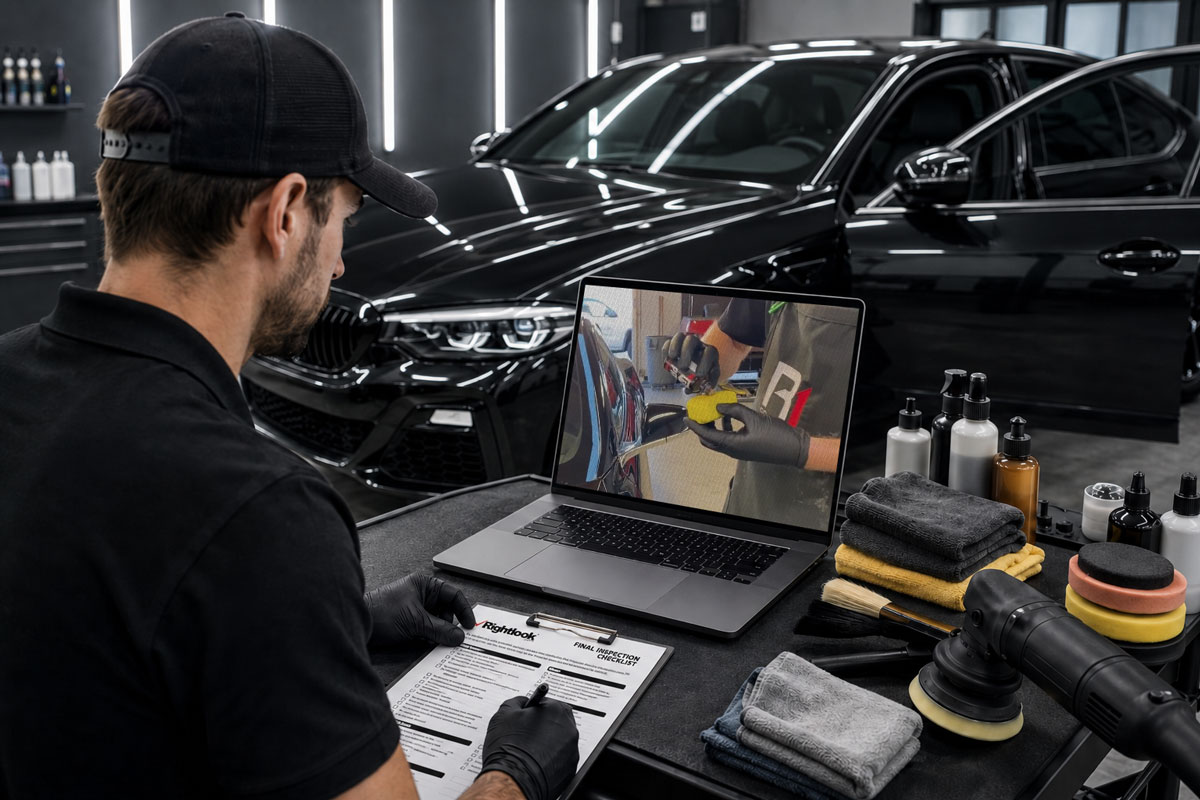
For example, checklists, inspection sheets, and other downloadable documents can be used on actual customer jobs. These tools help connect training with day to day business operations.
A Certificate of Completion
A certificate gives you printable proof that you completed a professional curriculum.
However, the value of that certificate depends on the training behind it. Our guide on how to become a certified auto detailer explains what these credentials mean in an industry without a government licensing requirement.
Rewatchability and Pace Control
One of the strongest advantages of online training is the ability to return to the material.
Before buying, confirm that the course is divided into clear, easy to find sections. That is much more useful than one long recording when you need to review a specific technique months later.
A Supplier Behind the Training
There is also value in learning from a company that works directly with professional detailers and supplies the equipment they use.
Training can then connect naturally to the products, tools, and support needed to perform the work.
In some cases, students may also receive discounts on equipment and supplies.
Red Flags Worth Avoiding
Not every course provides the same level of professional training.
Be cautious if a program does not show its module list before purchase. You should know what you are buying before you enroll.
Also look closely at who created the material. Generic learning platforms may offer detailing courses without a strong connection to the professional detailing industry.
Another warning sign is a program that promotes the certificate more heavily than the curriculum. Skills should come first. The certificate simply documents that training.
Be skeptical of income promises too. Training can improve your skills, but no course can guarantee business results. That is why we publish an earnings and income disclaimer.
Finally, consider what happens when you have a question. A professional training provider should offer a way to reach a real person for support.
Frequently Asked Questions
How Many Hours of Content Should an Auto Detailing Course Have?
There should be enough content to cover the full professional process with meaningful depth.
However, raw runtime is not the best measure of quality. Instead, judge whether each major subject is covered thoroughly and in a logical sequence.
Should the Course Cover Mobile or Shop Detailing?
The core detailing skills are the same in either setting.
Mobile versus fixed location operations are business model decisions rather than different detailing techniques.
Do I Need Paint Correction and Ceramic Coating Modules if I Am Starting With Basic Details?
Yes. You may not offer those services immediately, but they are important parts of the professional trade.
Learning the complete process once also prevents you from having to purchase another course later when you are ready to expand your services.
I Have a Limited Budget. Should I Save Longer for Classroom Training?
Not necessarily.
Online delivery can provide a complete professional curriculum without many of the additional costs associated with travel and lodging.
As a result, more of your startup budget can remain available for equipment, branding, marketing, and business systems.
The important question is the quality and completeness of the instruction, not the building where you receive it.
What Comes After the Course?
Practice comes next.
After that, you need to build the business around your skills through pricing, marketing, customer acquisition, and strong operations.
Training teaches the craft. Our Marketing Mastery program provides additional education focused on marketing and growing an auto appearance business.
Measure Any Course Against This List
That includes ours.
Rightlook.com’s Online Advanced Auto Detailing Training covers all nine subjects outlined above.
It also includes bonus content such as headlight restoration, downloadable business documents, exclusive product discounts, and a printable certificate of completion.
Use this checklist to compare your options first.
Then, if you have questions, view the Online Advanced Auto Detail Training course, call 858-271-4271, or text us.
Image note: Some images in this article may be AI-generated or AI-enhanced for illustrative purposes and may differ from the actual product.