

02 Sep How to Get Water Off a Containment Mat: Pumps, Wet Vacs, and Scoops Compared
A containment mat solves the first problem of compliant mobile washing: the water stays put. Then you meet the second problem. There are gallons of dirty water pooled on a mat, the job is done, and the water has to leave in your control rather than over the berm.
Detailers solve water recovery three ways. Here is how each works, what it costs you in time, and how to pick the right one for your operation.
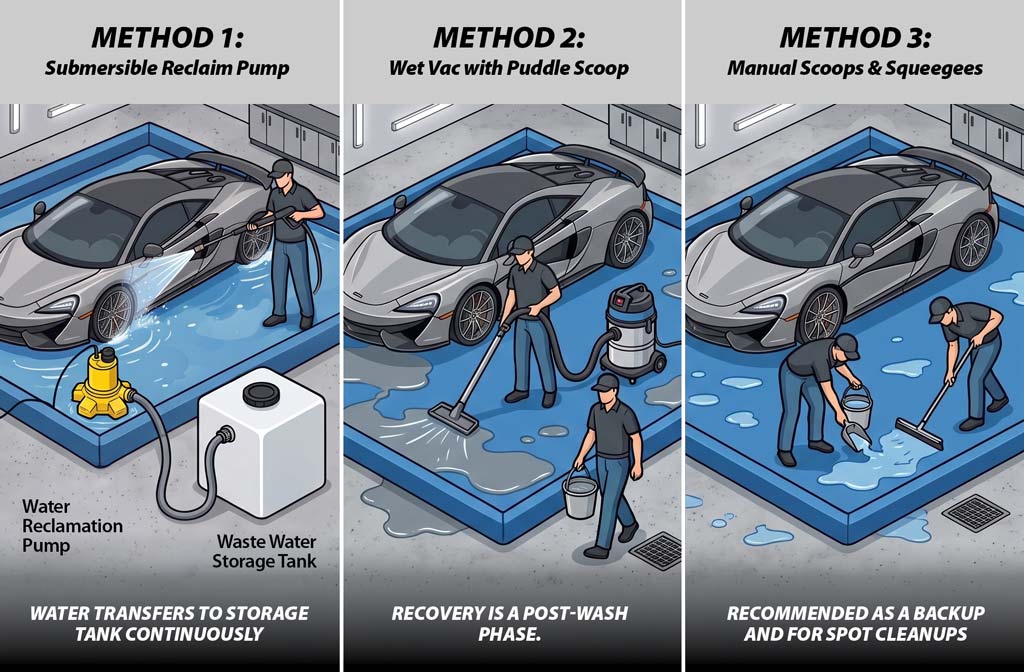
Method 1: A Submersible Reclaim Pump (The Professional Standard)
A flat style submersible pump sits directly on the mat at its lowest point. Connect a discharge hose from the pump to a storage tank, plug the pump into a GFCI protected outlet once water starts to accumulate, and it transfers water to the tank continuously while you keep washing.
The numbers explain why this is the standard. A quality flat pump starts working in as little as three sixteenths of an inch of water and pumps down to about one sixteenth of an inch, which leaves the mat essentially dry. The pump works during the wash rather than after it, so recovery adds close to zero minutes to the job. And because the water lands in a sealed tank with a drain valve, disposal happens later at a location you have already approved, at a controlled rate.
Two operating rules: always use GFCI protection, since this is an electric pump in standing water, and unplug the pump when the water is gone, because these pumps have no switch and running dry damages the motor.
Best for: daily mobile volume, fleet and commercial work, and anyone who would rather wash cars than manage puddles.
Method 2: A Wet Vac With a Puddle Scoop
A wet dry vacuum will pull water off a mat, and a purpose built puddle scoop attachment makes it practical. The scoop is a flat intake that glides along the mat surface, with a micron mesh filter at the bottom that keeps grit, leaves, and debris out of your vacuum motor. Vacuum the pooled water, empty the vac into an approved drain, and repeat until the mat is dry.
The tradeoffs are physical. Recovery happens after the wash, as its own phase of the job. A typical wet vac holds far less than a wash produces, so you will empty it multiple times, and every carry to the drain is a chance to slosh dirty water onto clean pavement. On jobs without a nearby approved drain, the vac’s capacity becomes your limit.
Best for: lower volume operators who already own a good wet vac, and shops whose off site work is occasional.
Method 3: Manual Scoops and Squeegees
For small jobs, spot washes, or the last stubborn puddle, some detailers use hand scoops or push water to a collection point with a squeegee, then transfer it by bucket. As a primary method it is slow, wet work that does not scale past the occasional job. As a backup it is worth having: a scoop in the rig covers you when a pump or vac has a problem mid route.
Best for: backup duty and very small cleanups, not a primary recovery method.
The Comparison at a Glance
- Time added per job: pump, almost none, since it runs during the wash. Wet vac, fifteen minutes or more of post wash work. Manual, the most of all.
- Capacity: pump plus tank handles a full job in one pass. Wet vac needs repeated emptying. Manual is bucket by bucket.
- Disposal flexibility: the pump’s tank travels with you for disposal anywhere approved. Vac and manual methods need a legal drain at or near the site.
- Equipment cost: manual is cheapest, wet vac assumes you own one, and the pump and tank cost the most up front while saving labor on every job afterward.
- Spill risk during recovery: lowest with the sealed pump and hose path, highest with carried containers.
Whichever Method: The Water Still Needs a Legal Home
Recovery is the middle step. The water you collect must go to the sanitary sewer with permission or another approved disposal point, never a storm drain. Our guide to disposing of reclaimed wash water covers the options and the tank draining procedure, and our regulations guide explains what the rules require end to end.
Frequently Asked Questions
Can I use any sump pump on a wash mat?
The mat needs a pump designed for shallow flat surface pickup. Standard sump pumps stop working with an inch or more of water remaining, which leaves you back on the mat with a scoop. Flat style utility pumps that pull down to a sixteenth of an inch are built for exactly this job.
Does the pump clog with dirt and grit?
Wash water grit passes through a utility pump far better than through a vacuum motor, and rinsing the pump with clean water after each use keeps it healthy. Keep leaves and large debris off the mat as you work.
How big a tank do I need?
A 50 gallon class tank covers typical wash volumes comfortably. Roughly three quarters of the water you use ends up on the mat.
Can I combine methods?
Many detailers do: pump as primary, scoop as backup, and a wet vac already on the rig for interiors that can pinch hit for water recovery if the pump has an issue.
Skip the Puddle Management
The complete Wash Mat Kit Water Reclamation System from Rightlook.com pairs the mat with the reclaim pump, 25 foot hose, scoop, and wastewater tank, so recovery happens while you work. Prefer to build around your own wet vac? The mat and puddle scoop are available in our car wash mats and grey water containment collection. Call or text 858-271-4271 with questions.
Image note: Some images in this article may be AI-generated or AI-enhanced for illustrative purposes and may differ from the actual product.